Nicaragua's economy maintains 4.1% growth in the first half of 2026
Tuesday, September 22, 2026 8:11 AM
During the first half of 2026, the Nicaraguan economy maintained the growth trend seen in recent years, expanding by 4.1% and showing positive performance across several key productive sectors. This information was shared by Ovidio Reyes, President of the Central Bank of Nicaragua (BCN), during an interview on the program Estudio TN8.
This result falls within the growth range projected by the BCN for the year—between 3.5% and 4.5%. Reyes noted that, based on currently available data, economic activity is progressing in line with expectations set for 2026.
"This first half continued the economic growth trend we have observed over the last five years," Reyes explained, highlighting that this performance has held steady despite an international landscape marked by higher oil prices and other factors affecting the global economy.
The BCN president noted that this growth is not driven by a single sector but rather by the combined performance of various activities, though he specifically identified exports and construction as two of the economy's main engines.
Exports maintain momentum in Nicaragua
One of the standout components of the first-half results is the export sector.
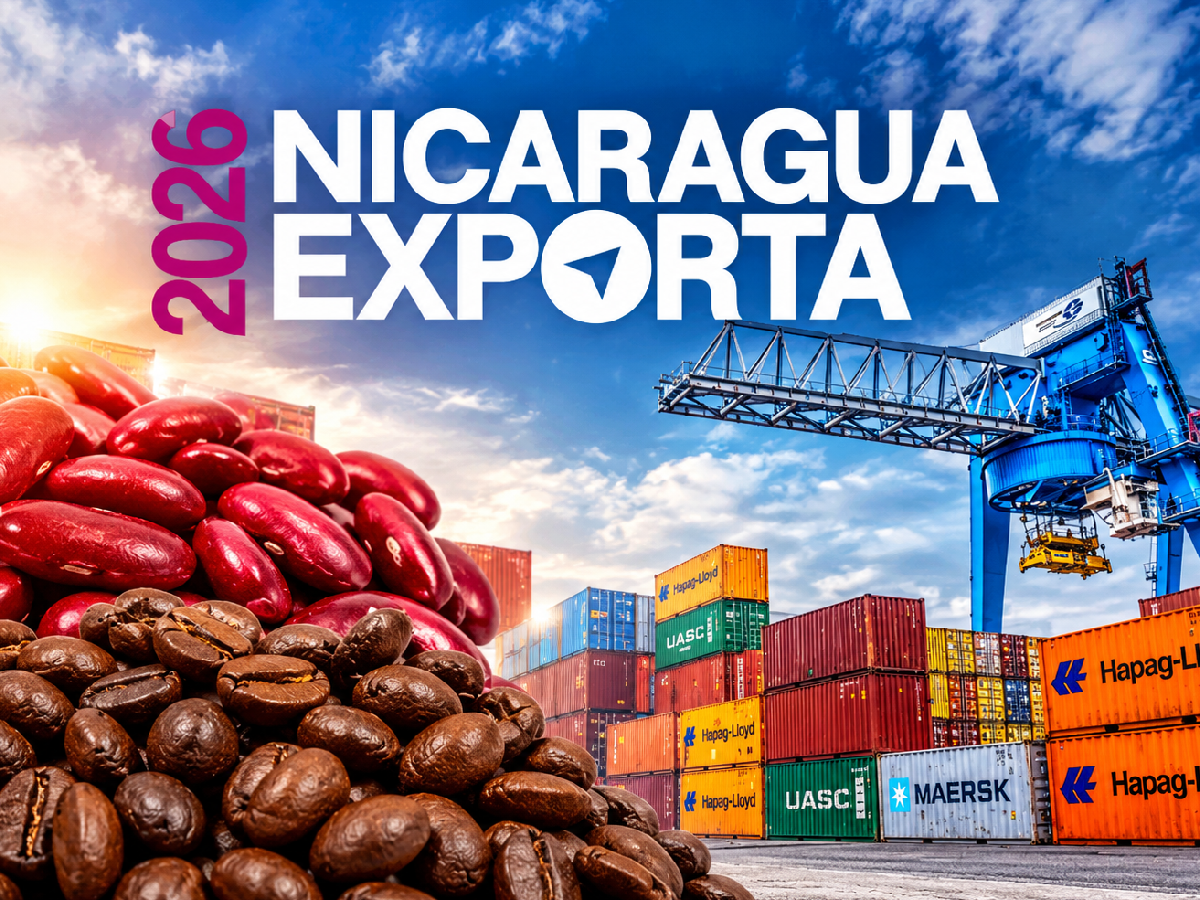
Between January and June, exports reached $5.132 billion, up from the $4.439 billion recorded during the same period in 2025. This represents a year-on-year growth of 15.6%.
Reyes explained that while some products have faced price drops due to the international climate, the overall result remains positive.
"The positive aspect is that overall exports continue to rise," he stated.
Key products exported during the first half included gold ($1.523 billion), coffee ($629 million), meat ($569 million), and sugar ($146 million). ...dairy products, with 120 million; silver, with 56 million; beans, with 54 million; peanuts, with 40 million; and lobster, with 27 million.
Performance varied across different segments in Nicaragua. Free trade zone exports fell by 10.1%, while other products saw growth that kept the overall export result on a positive trajectory.
“So, the engines—or the pillars—of Nicaragua’s economic momentum remain intact,” Reyes noted, referring to the performance of the export and construction sectors.
Construction accelerates and sustains activity
The other major component highlighted during the interview was construction, which recorded growth of 16.7% in the first quarter and 30.4% in the second.
This activity has been driven by both public and private investment. According to data presented by Reyes, public investment grew by 31.2% in the second quarter, while private investment rose by 16% in the first quarter and 13.8% in the second.
For the BCN president, the impact of construction extends beyond the projects themselves, given the volume of economic activity generated around them.
“Construction is a sector that not only creates infrastructure but also generates significant employment, as it is labor-intensive,” he explained.
Added to this is the impact on other activities linked to materials, transportation, services, and commerce.
Consumption and services also advance in Nicaragua
Economic performance during the first half of the year was also driven by activity in the trade, hotel and restaurant, transport, communications, and financial intermediation sectors.
The trade sector grew by 15.8% in the first quarter and 6% in the second. Meanwhile, hotels and restaurants recorded increases of 9.8% and 9.1%, respectively.
"We are seeing a complementarity between production, consumption, and service provision—right?—along with an overall expansion in aggregate demand," Reyes explained.
Transport and communications grew by 3.7% in the first quarter and 6.4% in the second, while financial intermediation advanced by 5.8% and 4% during those same periods.
The BCN president also highlighted that service-sector growth is an integral part of the economy's productive activity, noting the employment and income generated by sectors such as trade, restaurants, and other services.
Employment remains a key indicator
In addition to production growth, employment is one of the indicators the BCN uses to assess economic performance.
Reyes placed the unemployment rate at 3.1%, falling within the 2.5% to 3.5% range the institution uses as a benchmark.
"And regarding the unemployment rate, we are at 3.1%. In fact, we are right on target," he noted.
The official explained that the indicator used encompasses both wage earners and self-employed individuals or those engaged in independent economic activities.
Inflation remains a major challenge for Nicaragua
Economic growth is occurring alongside external pressures, particularly those stemming from rising international prices and oil market trends.
Reyes noted that year-on-year inflation is hovering around 4%, while the BCN’s projection for 2026 remains between 2.5% and 3.5%.
“We believe we can reach the 3.5% target—the upper limit of the goal—though we might end up slightly above that if the global situation does not stabilize,” he explained.
The official attributed much of this pressure to the behavior of international prices, particularly the rising cost of oil and its impact on production, transportation, and imported goods costs.
An economy maintaining its growth projection
Based on results from the first half of the year, the BCN maintains its expectation that Nicaragua will close 2026 within the projected growth range.
Reyes noted that 2025 ended with 4.9% growth and pointed out that the economy has seen five consecutive years of sustained growth, averaging close to 4.5%.
“We believe we will remain within the growth range projected for 2026,” he stated.
The picture presented during the interview depicts an economy experiencing growth in production, exports, construction, commerce, and services, even though specific sectors are facing challenges due to climatic and external factors.
Wrapping up the interview, Reyes summarized the outlook for the coming months, noting that continued growth and job creation are expected, while the trend in international prices remains a key factor to watch.
“We expect to end the year in a strong position, with GDP growth and continued job creation, alongside inflation that will be somewhat influenced by international prices,” he concluded.
Source: TN8